Saturday, March 26, 2011

Photosynthesis: Environmental Factors

Rate of photosynthesis:
Measured by the net CO2 uptake: photosynthetic uptake – photorespiratory evolution – respiratory evolution

There are 4 main factors affecting the rate of photosynthesis in plants:

1) Light Intensity
Generally, as light intensity increases, the rate of photosynthesis also increases.
When there is no light, net CO2 production is negative due to cellular respiration.
Light-compensation point - when the amount of CO2 used is equal to the CO2 produced: net CO2=0
Light Limited phase - For sometime, the rate of photosynthesis increases in direct proportion to light (the relationship is linear). The reaction is speeding up as substrate concentration is increasing until the enzymes are working at full potential.
Light Saturation point - carbon fixation has reached maximum rate: enzyme concentration in limiting.

2) Temperature
Between 10-30 degrees: rate increases with temperature.
40 + degrees: the enzymes which catalyze the reactions within photo synthesis become denatured and are no longer able to function. This causes the rate to decrease after this point.

3) Carbon dioxide Concentration
Generally, the higher the concentration of CO2 in the atmosphere, the higher the rate of photosynthesis.
The enzyme rubisco involved in the Calvin Cycle also has a high affinity for oxygen. The greater the carbon dioxide concentration, the less chance RuBP will oxidized.
Once again, this increase in rate of photosynthesis is only until the enzymes involved are working at full potential.

4) Water Concentration
Water is another reactant in photosynthesis, and therefore causes an increase in reaction rate also until the enzymes are working at their full potential.

Can a plant get too much water?

Yes, in large plants, root cells are responsible for carrying water to upper cells for photosynthesis. They, themselves, perform cellular respiration to survive which requires oxygen which they absorb from air pockets in the soil. If the soil is completely saturated with water, no oxygen will be absorbed by these cells, and they will die. This may eventually lead to the death of the entire plant.

Photosynthesis: Alternative Mechanisms

The type of photosynthesis discussed in the last blog is referred to as C3 photosynthesis. Some plants have slightly modified mechanisms of carbon fixation due to a particularly dry climate.

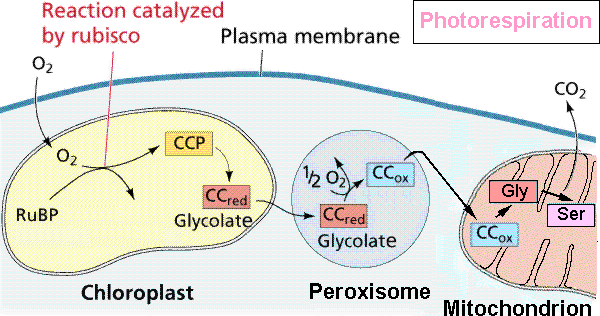
Photorespiration- The oxidation of RuBP:

How it happens?
When it is warm, plants close their stoma to save water.
CO2 cannot enter the leaf.
Oxygen concentrations increase.
Oxygen, instead of Carbon dioxide, then bonds to RuBP.

The result?
Less carbohydrates are produced by photosynthesis since PGA molecules are removed— instead of 2 PGAs which are produced during photosynthesis, only one PGA and another 2 carbon glycolate are formed from RuBP.

How is it overcome in hot climates?

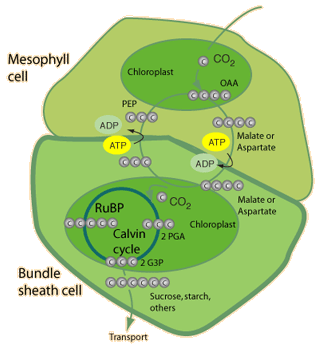
C4 photosynthesis
The blow is a good summary of C4 photosynthesis:

Overall, CO2 is added to a 3-carbon PEP molecule forming a 4-carbon OAA, and then malate, which then passes into the bundle sheath cells where the CO2 can be released and used for photosynthesis.

Location: Cytoplasm of mesophyll cell/bundle sheath cell. (spatial separation)
Note:
C3 Photosynthesis: 18 ATP used per glucose molecule.
C4 Photosynthesis: 30 ATP used per glucose molecule.

Crassulacean acid metabolism (CAM)
The below is a good summary of CAM:

Overall, during the night, CO2 is stored in the vacuoles of the plant in the form of organic acids. During the day, this CO2 is released and used for photosynthesis.

Location: Cytoplasm (all in one place; different from C4 photosynthesis - Temporal Separation: day/night)

Wednesday, March 23, 2011

Photosynthesis: Calvin Cycle

Although the Calvin Cycle does not rely directly on exposure to the sun for energy, its enzymes still require sunlight to be activated. This cycle follows the light reactions and is where the carbohydrates are synthesized.

The bellow diagram illustrates the process well.


It is divided into 3 phases:

1)Carbon fixation
3 carbon dioxide + 3RuBP -> unstable 6 carbon compound -> 3 PGA
Enzyme : Rubisco (Most abundant protient on earth. Also large.)

2)Carbohydrate synthesis
3PGA + 6ATP -> 6 1,3-bisphosphoglycerate + 6ADP
Enzyme: PGA kinase
1,3-bisphosphoglycerate + 6NADPH -> 6G3P + 6 Pi + 6NADP+
Enzyme : G3P dehydrogenase
*Note : 1G3P -> SUGAR

3)Ribulose biphosphate (RuBP) regeneration
5G3P + 3ATP -> 3RuBP + 3ADP + 2Pi

Overview:
Net ATP: -9
Location: Stroma
Reactants : 3 RuBP + 3CO2 + 9ATP + 6 NADPH + 5 H2O
Products: 9 ADP + 8Pi + 6 NADP+ + G3P + 3 RuBP

Tuesday, March 22, 2011

Photosynthesis: Cyclic Electron Flow

In some cases, the electrons may take an alternate cyclic pathway in which pigments capture energy from the sun in photosystem 1.


As per usual, the energy is transferred to the alpha glucose in the reaction centre and an electron is transferred to the primary electron acceptor.

From there, ferredoxin carries it to the b6-f complex and plastocyanin carries it back to photosystem 1 where it may replace another lost electron.

In the process, a proton gradient is created for ATP synthesis.

This type of electron flow DOES NOT allow for carbon fixation because there are no electrons released to form NADPH, a energy carrier necessary for the reduction of carbon dioxide.

Sunday, March 20, 2011

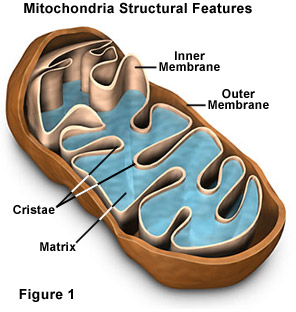
Photosynthesis: Chemiosmosis (Chloroplast vs. Mitochondria)


Mitochondria:

- electrons from organic substances
- chemical energy transferred to ATP
- electrons pumped from matrix to inner membrane space
- ATP goes into matrix

Chloroplast:

- electrons from water
- light energy transferred to ATP
- protons pumped from stroma to lumen (thylakoid space)
- ATP goes into stroma

Photosynthesis: Light Reactions

What is it?
Photosynthesis is the process by which autotrophs convert light energy into potential chemical energy which can then be used by both themselves and heterotrophs.

Where does it take place?
Photosynthesis occurs in the chloroplasts of plants which are usually located in the mesophyll tissues of their leaves.
To the right is an image of a chloroplast. Refer to it as we walk through the entire process.
Chlorophyll is the green pigment that absorbs the light energy.

Below is the electromagnetic spectrum. Visible light (from 380-750) is what powers photosynthesis. More specifically, the pigments responsible for capturing light absorb violet, blue and red light best. Green is reflected.

Embedded in the thylakoid membrane are numerous photosystems. These consist of light harvesting complexes containing chlorophyll-b,and a reaction-center complex containing 2 chlorophyll-a's and an electron acceptor.
When light is absorbed by electrons in the chlorophyll are excited. The energy is transferred from chlorophyll-b molecules to the chlorophyll-a molecule from which the excited electron can be ejected and captured by the electron acceptor.

In photosystem 2, the electron that is lost from the a-chlorophyll is replaced by an electron obtained from the splitting of water into oxygen and hydrogen ions. The hydrogen ions remain in the lumen and contribute to the charge buildup.

From the primary electron acceptor, the electron proceeds through a transport chain consisting of plastoquinone, a cytosome complex, and plastocyanin. In this process, more H+ are pumped into the lumen allowing for ATP synthesis using an ATP synthase structure similar to the one used in cellular respiration.
Note: 4H+ yield 1ATP

At the end, this electron is passed to photosystem 1 where it replaces an excited electron that has been used to create NADPH.

This process is summarized well in the diagram below.

Overview
Net ATP: 24
Location: Thylakoid Membrane
Reactants : 48 Photons + 12 water + 24ADP + 12NADP+
Products: 6O2 + 24ATP + 12NADPH

Saturday, March 19, 2011

Fermentation

Fermentation occurs when there is not enough oxygen present (in anaerobic conditions).
In such conditions, only glycolysis may proceed, but the pyruvate is unable to enter the other components of cellular respiration. The 2 ATPs gained by glycolysis alone is enough to sustain simple life forms, like yeast.

Glycolysis requires the presence of NAD+ which only exists in limited quantities within cells. If this supply runs out, glycolysis can no longer proceed, and the cell will no longer have a source of energy. To overcome this, cells have developed the process of fermentation.

There are 2 types of fermentation: alcoholic fermentation (done by yeast cells) and lactic acid fermentation (done by animal cells)

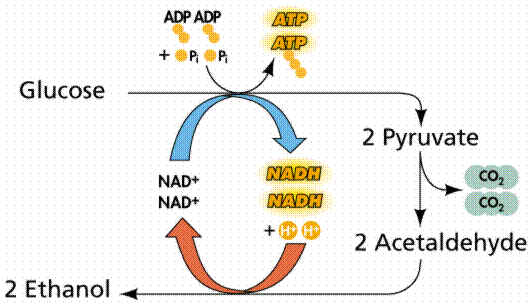
Alcoholic Fermentation:
In alcoholic fermentation, pyruvate is made into ethanol. Ethanol is the final electron acceptor. In the process, NAD+ is changed back to NADH allowing the cycle to continue.

Humans take advantage of alcoholic fermentation to create alcoholic beverages.


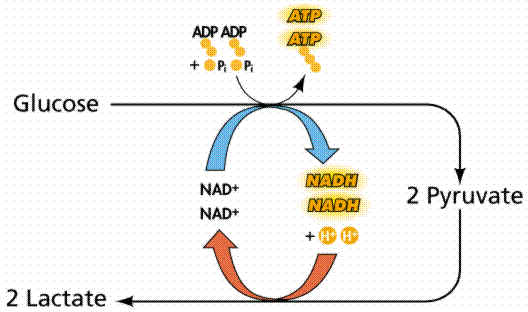
Lactic Acid Fermentation:
In lactic acid fermentation, pyruvate is made into lactate. Lactate is the final electron acceptor. In the process, NAD+ is changed back to NADH allowing the cycle to continue.

Lactic acid fermentation occurs in human muscles cells during a work out when not enough oxygen is present to meet the demands of the cells. This causes the burn.